Anatomy of a tile request: COG vs GeoZarr
What happens on the wire when rio-tiler serves one 256×256 web-map tile
from the same Sentinel-2 band (B04, red), stored as a COG and as a GeoZarr.
Note
This post, along with its benchmark scripts and figures, was written with the help of Claude Code (Anthropic).
The two datasets
Both are the same scene: Sentinel-2 tile 26SMJ, 2026-08-10, 10980×10980 px at 10 m, EPSG:32626.
| COG | GeoZarr (EOPF) | |
|---|---|---|
| URL | cogs/S2C_26SMJ_20260810_0_L2A_B04.tif |
geozarrs/S2C_MSIL2A_…_T26SMJ_….zarr/measurements/reflectance |
| Content | one band | all bands × all resolutions (87 arrays) |
| dtype | uint16 |
float32 |
| Compression | DEFLATE + predictor 2 | Blosc (zstd, shuffle) |
| Internal tiling | blocks of 1024×1024 | 1 shard per level, inner chunks of 244×244 (r10m) / 183×183 |
| Pyramid | overviews ×2, ×4, ×8, ×16 (same file) | r10m r20m r60m r120m r360m r720m (sibling groups) |
| Metadata | TIFF header, read the first 32 KB | consolidated zarr.json, 166 KB |
| Size (B04 full res) | 222 MB file | 374 MB shard (r10m/b04/c/0/0) |
Bucket: https://titiler-benchmark-public.s3.us-east-1.amazonaws.com
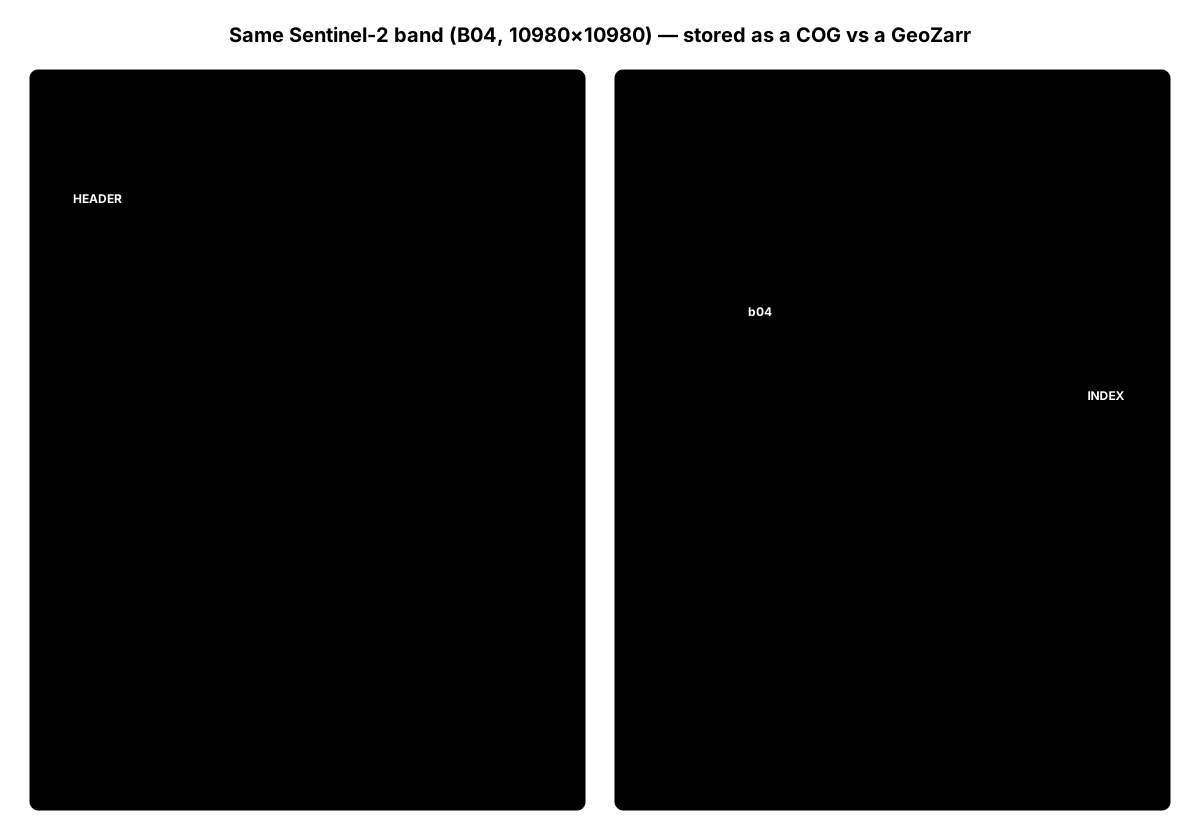
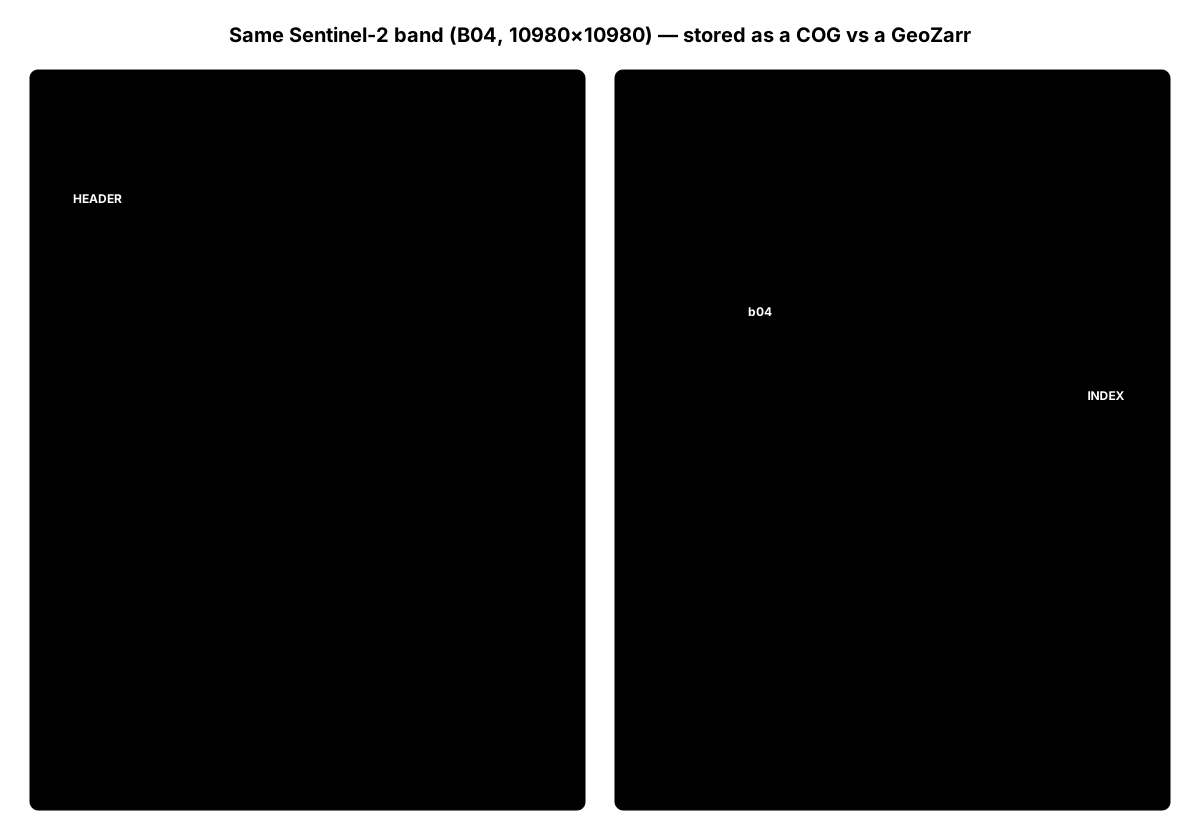
A tile request, in two steps
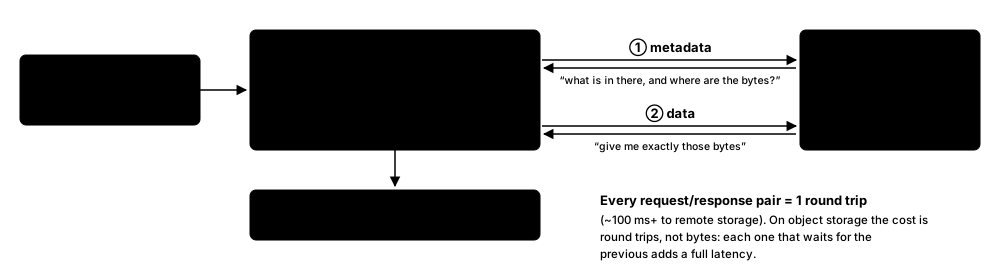
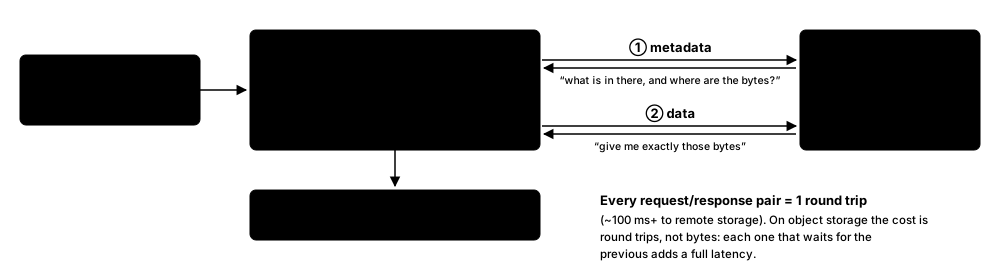
On object storage the cost is round trips, not bytes. Each round trip that has to wait for the previous one adds a full latency.
COG — ① read the header
One ranged GET for the first 32 KB. The header contains everything: the image layout (IFDs) and the byte offset of every block of every level.
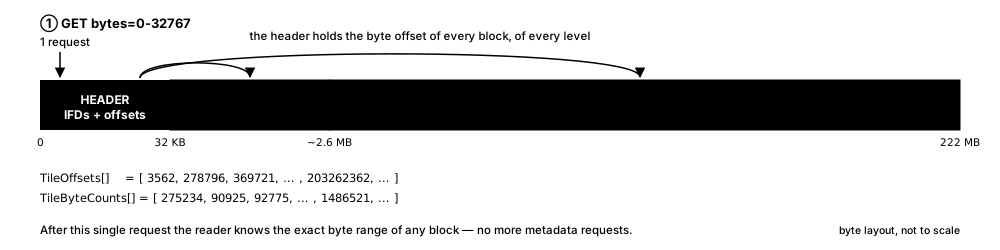
After this single request, the reader knows the exact byte range of any block. No more metadata requests are needed.
COG — ② fetch the blocks
The tile footprint is intersected with the 1024×1024 block grid. All the needed blocks are fetched in parallel — a single round trip.
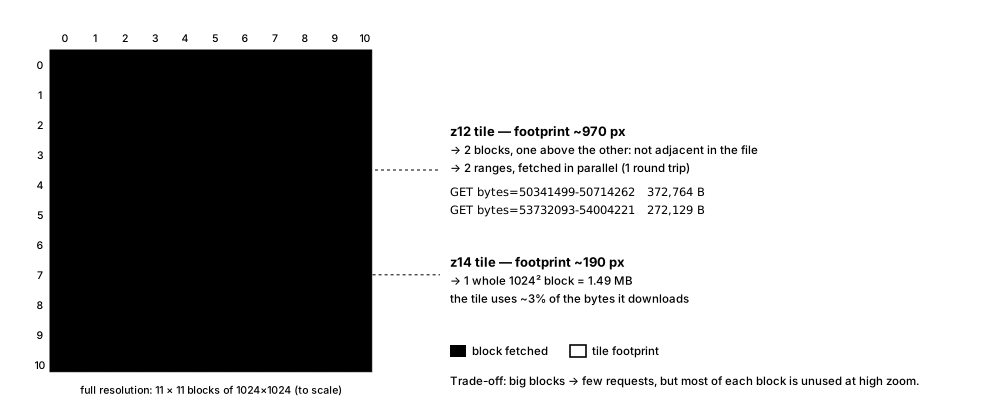
Trade-off: big blocks → few requests, but a z14 tile uses only ~3% of the 1024² block it downloads.
GeoZarr — ① read zarr.json
The GeoZarr is a hierarchy: one group per resolution, one array per band.
With consolidated metadata, the root zarr.json already describes all of it.
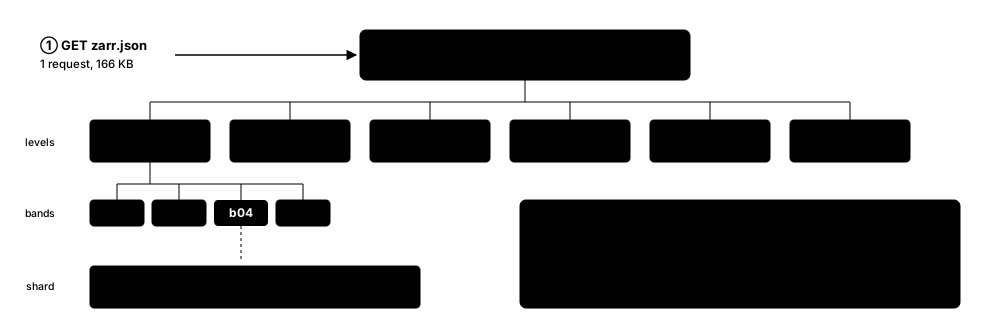
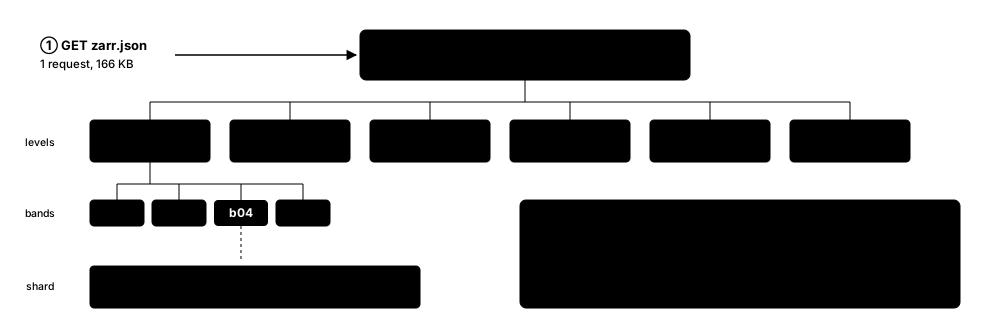
What zarr.json tells us: shapes, transforms, chunk grid, codecs.
What it does not tell us: where each inner chunk sits inside the shard.
GeoZarr — ② the shard index, then the chunks
A shard is a file with many compressed inner chunks plus an index at the end
(offset, nbytes per chunk). Reading a chunk is a two-step dance:
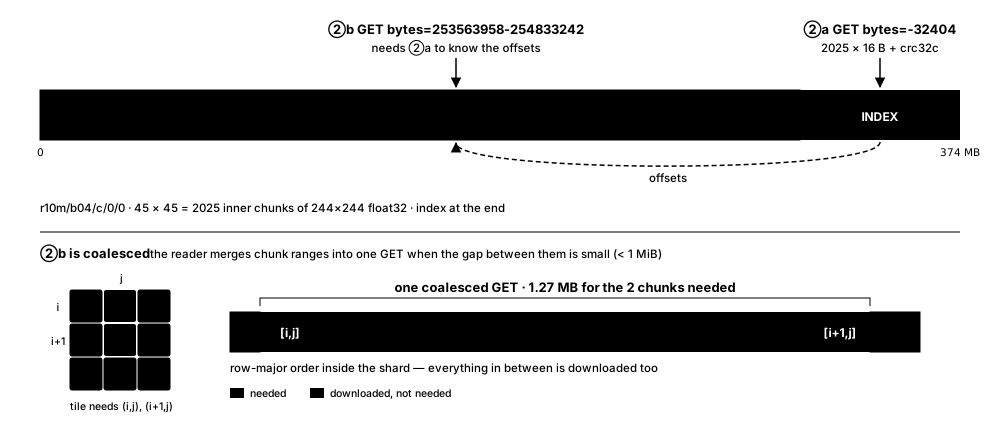
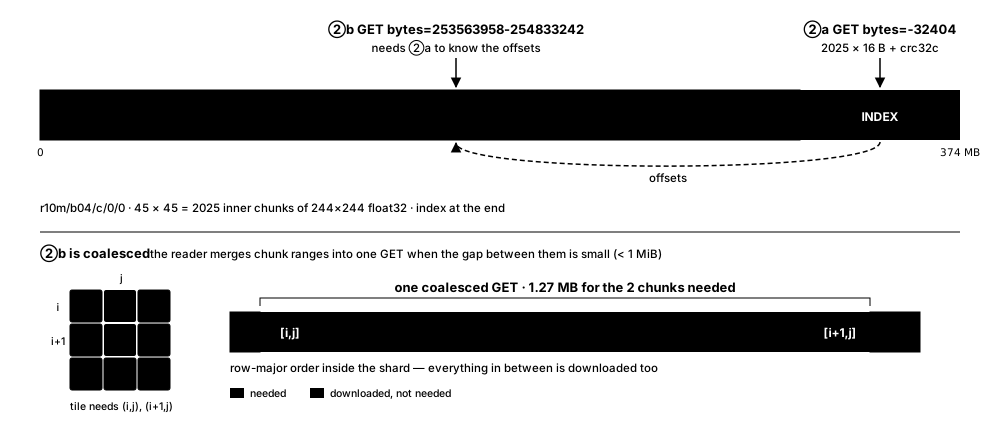
②b is coalesced: zarr-python merges the chunk ranges into one GET when the gap between them is < 1 MiB — even if that means downloading the chunks in between.
Side by side: the round trips
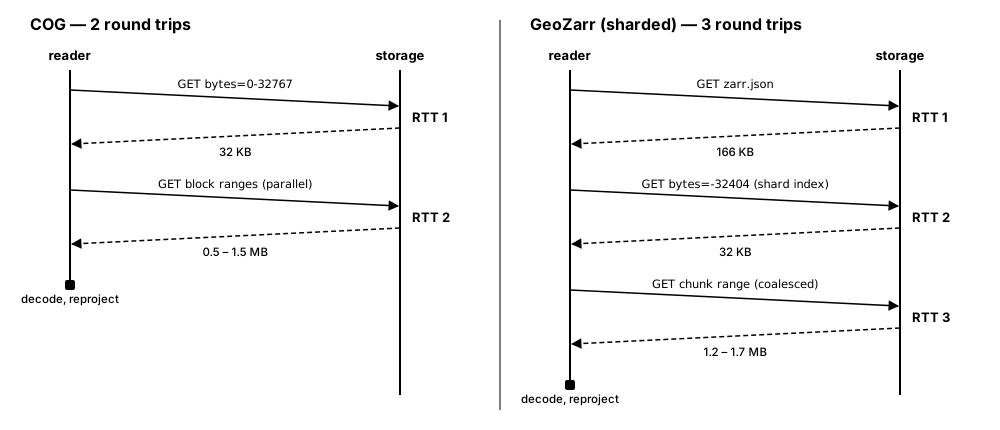
COG: 2 dependent round trips. GeoZarr (sharded): 3.
Profiles (1 Band)
Requests and bytes
Async readers (rio_tiler.experimental.geotiff.Reader / rio_tiler.experimental.zarr.AsyncGroupReader),
one cold store per request, every byte range recorded.
| Tile | Level used (COG / Zarr) | COG GETs | COG bytes | Zarr GETs | Zarr bytes |
|---|---|---|---|---|---|
14/6944/6268 |
full res / r10m |
1 + 1 | 1,519,289 | 1 + 1 + 1 | 1,467,606 |
12/1736/1567 |
full res / r20m |
1 + 2 | 677,661 | 1 + 1 + 1 | 1,895,980 |
10/434/391 |
overview / r120m |
1 + 4 | 864,440 | 1 + 1 + 1 | 1,355,346 |
9/217/195 |
overview / r120m |
1 + 4 | 532,687 | 1 + 1 + 1 | 1,748,580 |
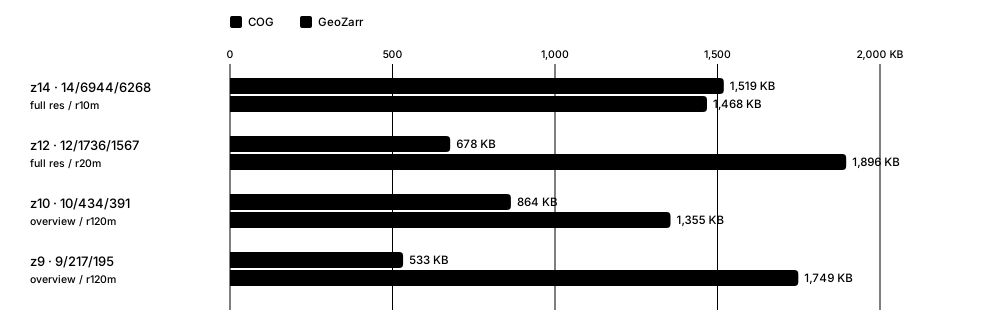
- COG metadata is 32 KB; Zarr's is 166 KB (it describes 87 arrays, we use 1).
- Zarr over-reads because of coalescing, and because it stores
float32(vsuint16).
Time
10 runs per tile, median, from a laptop over the public internet to us-east-1.
| Tile | COG open | COG tile | COG total | Zarr open | Zarr tile | Zarr total |
|---|---|---|---|---|---|---|
| z14 | 524 ms | 634 ms | 1158 ms | 636 ms | 275 ms | 926 ms |
| z12 | 522 ms | 636 ms | 1173 ms | 662 ms | 282 ms | 978 ms |
| z10 | 532 ms | 540 ms | 1081 ms | 666 ms | 277 ms | 998 ms |
| z9 | 519 ms | 432 ms | 954 ms | 712 ms | 294 ms | 1006 ms |
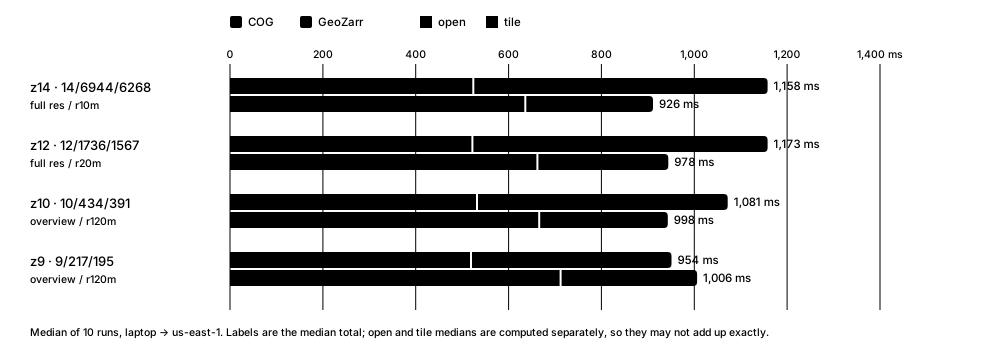
- Open is dominated by the first request (DNS + TLS + cold connection): ~500 ms for both.
- Totals are within ~20% of each other. Run-to-run spread on Zarr went up to 1.8 s.
Why is Zarr's tile step faster with more round trips?
Not explained by the format. What we checked:
- A bigger first read warms the TCP connection: fetching the same 1.4 MB COG range after a 166 KB read instead of a 32 KB one: 562 → 418 ms (median, 8 runs). Zarr always opens with 166 KB.
- The rest of the gap is not explained yet. Identical 1.4 MB range GETs varied from 140 ms to 600 ms between runs from this machine.
Profiles (3 Bands)
A true-color tile needs three bands (RGB). As COGs that means three files; in the GeoZarr it is three arrays of the same store.
- COG:
rio_tiler.experimental.async_stac.AsyncSTACReaderwith a STAC Item listing the three files, fetched from the bucket (cogs/S2C_26SMJ_20260810_0_L2A.json, 2.7 KB). Each asset is opened withasync-geotiff(rio_tiler.experimental.geotiff.Reader) and its own obstoreHTTPStore, since in real life the files can live in different buckets. - GeoZarr:
rio_tiler.experimental.zarr.AsyncGroupReader.
@asynccontextmanager
async def reader(url: str, *args, **kwargs):
    parsed = urlparse(url)
    store = HTTPStore.from_url(f"{parsed.scheme}://{parsed.netloc}{posixpath.dirname(parsed.path)}")
    geotiff = await GeoTIFF.open(posixpath.basename(parsed.path), store=store)
    async with Reader(geotiff, *args, **kwargs) as src:
        yield src

item = json.loads(httpx.get("https://titiler-benchmark-public.s3.us-east-1.amazonaws.com/cogs/S2C_26SMJ_20260810_0_L2A.json").content)
async with AsyncSTACReader(input=item, reader=reader) as dst:
    img = await dst.tile(1736, 1567, 12, assets=["B04", "B03", "B02"])

async with AsyncGroupReader(input=group) as src:
    img = await src.tile(1736, 1567, 12, variables=["b04", "b03", "b02"])
Round trips
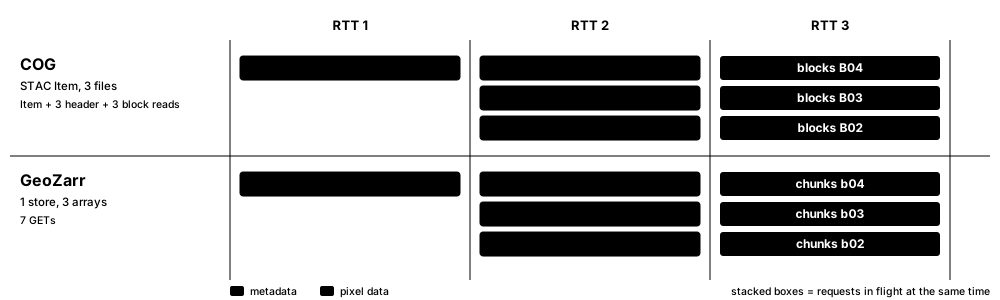
- COG: the STAC Item first (bounds, CRS and zooms come from its
proj:*fields, so the reader doesn't open any file to get them). Then the three bands concurrently: one header per file, then the blocks of each file → 3 dependent round trips. - GeoZarr:
zarr.jsononce, then the three shard indexes together, then the three chunk reads → 3 dependent round trips.
Same shape on both sides: the STAC Item plays the role of zarr.json, then one metadata
read per band, then one data read per band.
Requests and bytes
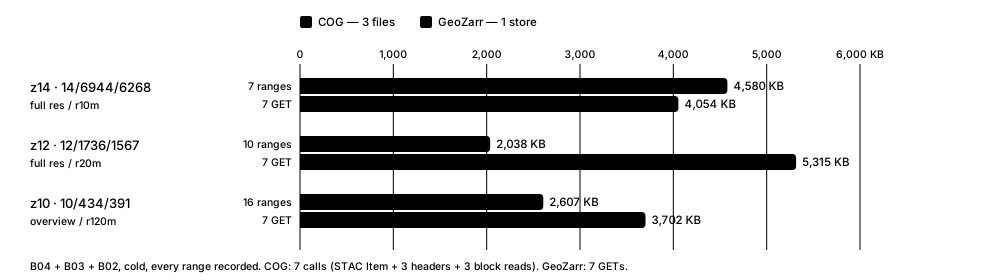
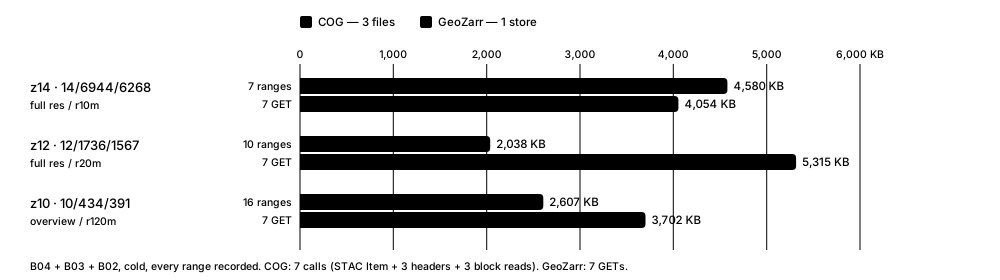
| Tile | COG calls | COG bytes | GeoZarr GETs | GeoZarr bytes |
|---|---|---|---|---|
14/6944/6268 |
Item + 3 headers + 3 block reads (7 ranges) | 4,579,541 | 7 | 4,053,842 |
12/1736/1567 |
Item + 3 headers + 3 block reads (10 ranges) | 2,038,332 | 7 | 5,315,058 |
10/434/391 |
Item + 3 headers + 3 block reads (16 ranges) | 2,606,638 | 7 | 3,701,878 |
- Metadata: COG = 2.7 KB STAC Item + 3 × 32 KB headers; GeoZarr = one 166 KB
zarr.json+ 3 shard indexes. - COG bytes are ~3× the single-band numbers (z14: 3 × 1.52 MB ≈ 4.58 MB).
GeoZarr grows less than 3× because
zarr.jsonis paid only once (z14: 1.47 MB → 4.05 MB).
Time
10 cold runs per tile (fresh process each time), median, laptop → us-east-1.
| Tile | COG open | COG tile | COG total | Zarr open | Zarr tile | Zarr total |
|---|---|---|---|---|---|---|
| z14 | 500 ms | 1258 ms | 1778 ms | 687 ms | 1150 ms | 1849 ms |
| z12 | 496 ms | 1214 ms | 1718 ms | 689 ms | 1120 ms | 1814 ms |
| z10 | 490 ms | 1155 ms | 1650 ms | 695 ms | 983 ms | 1702 ms |
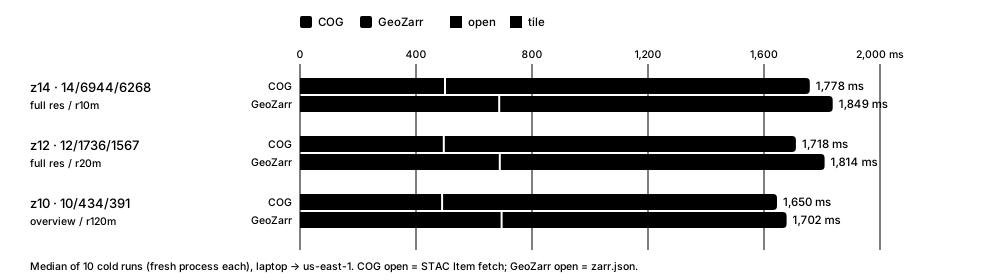
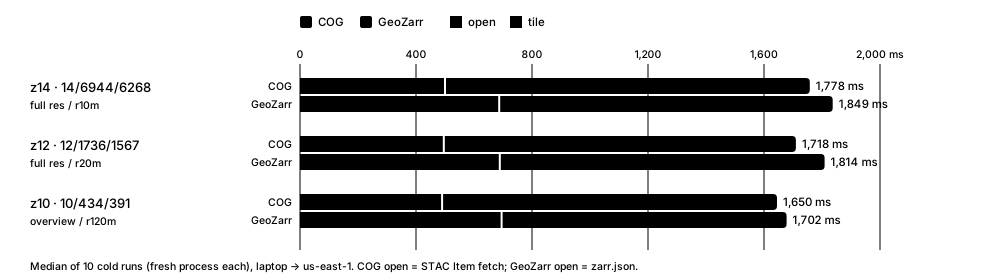
- COG and GeoZarr are within ~3–5% (1.65–1.78 s vs 1.70–1.85 s): same number of round trips.
- COG opens faster (2.7 KB STAC Item vs 166 KB
zarr.json, ~500 vs ~690 ms), but its tile step is ~100–170 ms slower: with one store per file, each band's first request opens a new HTTPS connection, while the three GeoZarr index reads reuse the one store's connections.
Takeaways
| COG | GeoZarr (sharded) | |
|---|---|---|
| metadata request | 32 KB, one file | 166 KB, whole hierarchy |
| dependent round trips | 2 | 3 (index lives in the shard) |
| read granularity | 1024² block | 244² / 183² inner chunk |
| bytes per tile | 0.5 – 1.5 MB | 1.4 – 1.9 MB |
| multi-band access | 1 file per band | 1 open for all bands |
| 3-band tile round trips | 3 (STAC Item, headers, blocks) | 3 |
- Round trips: COG has the block index in its header → 2 trips. A sharded Zarr needs to read the shard index first → 3 trips. Caching shard indexes (like the header) would bring Zarr down to 2 trips.
- Bytes: smaller inner chunks should mean fewer bytes, but coalescing
(1 MiB gap) and
float32storage cancel that out here. - Metadata: consolidated
zarr.jsonpays off when reading several bands or levels from the same store — and costs extra for a single-band tile. - Several bands: the round trips don't grow with the number of bands (bands are read
concurrently): 3 for both, with the STAC Item playing the role of
zarr.json. COG pays one header and one new connection per file; GeoZarr readszarr.jsononce and reuses the store's connections.
Reproduce
- Benchmarks:
tests/benchmarks/async_cog_benchmarks.py,tests/benchmarks/async_geozarr_benchmarks.py - Request assertions:
tests/benchmarks/requests.py,tests/benchmarks/geozarr_requests.py - Profiles:
uv run pytest tests/profiles/geotiff_profiles.py tests/profiles/zarr_array_profiles.py -s - Multi-band:
uv run python docs/scripts/cog_vs_geozarr/multiband_measure.py trace(requests),uv run python docs/scripts/cog_vs_geozarr/multiband_drive.py 10(timings) - Figures:
python3 docs/scripts/cog_vs_geozarr/make_figures.py
Recording byte ranges (the trick used for the numbers above):
# COG: wrap the obstore store given to async_geotiff.GeoTIFF.open
class TracingStore:
    def __init__(self, store): self.store, self.log = store, []
    async def get_range_async(self, path, *, start, end=None, length=None):
        r = await self.store.get_range_async(path, start=start, end=end, length=length)
        self.log.append((start, len(r))); return r
    async def get_ranges_async(self, path, *, starts, ends=None, lengths=None):
        r = await self.store.get_ranges_async(path, starts=starts, ends=ends, lengths=lengths)
        self.log += [(s, len(b)) for s, b in zip(starts, r)]; return r

# Zarr: WrapperStore forwards get_ranges() straight to the inner store,
# so route it through the base coalescer to see each merged GET in get()
class TracingZarrStore(zarr.storage.WrapperStore):
    log = []
    async def get(self, key, prototype, byte_range=None):
        r = await self._store.get(key, prototype, byte_range)
        self.log.append((key, byte_range, len(r) if r else 0)); return r
    def get_ranges(self, key, byte_ranges, *, prototype, **kw):
        kw = {k: v for k, v in kw.items() if v is not None}
        return zarr.abc.store.Store.get_ranges(self, key, byte_ranges, prototype=prototype, **kw)